


 (15)
(15)

9 min.
383
Medical expert for this article:

Sedation is not general anaesthesia: what is the difference?
Patients often confuse sedation with general anaesthesia, imagining a difficult recovery from anaesthesia, ventilators, and a long rehabilitation period. In reality, intravenous sedation is a medically induced state of sleep that is fundamentally different from traditional anaesthesia. Sedation does not involve a deep loss of consciousness. The patient sleeps very gently, breathes entirely independently, and retains all natural reflexes, including swallowing. The anaesthetist tailors the medication dose to the individual, and the process of falling asleep is pleasant — the person first relaxes, begins to smile, and then drifts off to sleep. You simply fall asleep in the chair and wake up with the four problematic teeth removed. There are no unpleasant sounds, pressure, or fear left in your memory. The only thing you feel after waking up is mild drowsiness and a desire to drink water, which completely disappears within half an hour.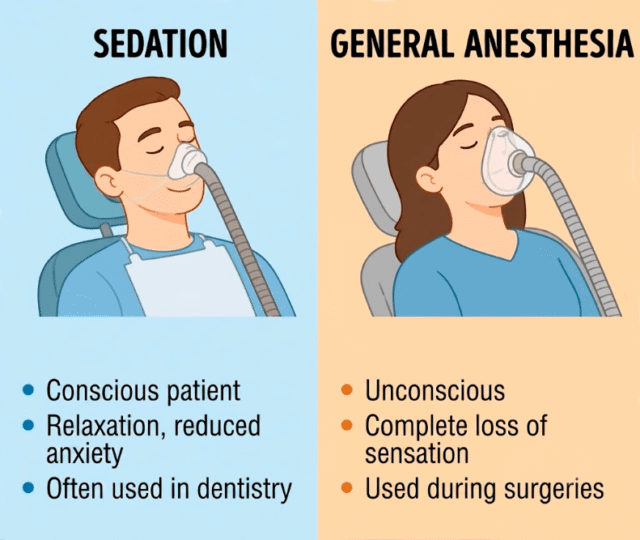 The difference between sedation (medicated sleep) and general anaesthesia: during sedation, the body retains all its natural reflexes and continues to breathe, making the procedure as gentle as possible.
But falling asleep gently is only half the story. Many people are frightened by what will happen after they wake up, once the effects of the medication have worn off. And this is where the main question arises: is it better to have all the teeth removed at once, or to spread the procedure out?
The difference between sedation (medicated sleep) and general anaesthesia: during sedation, the body retains all its natural reflexes and continues to breathe, making the procedure as gentle as possible.
But falling asleep gently is only half the story. Many people are frightened by what will happen after they wake up, once the effects of the medication have worn off. And this is where the main question arises: is it better to have all the teeth removed at once, or to spread the procedure out?
Why having four teeth extracted at once is the most sensible option
At first glance, it might seem that having one tooth removed is easier and safer than having four removed at once. But when viewed from the perspective of the body’s recovery, the logic changes. By having teeth removed one at a time, the patient is forced to undergo four surgical procedures, experience the stress of awaiting surgery four times, take courses of antibiotics and anti-inflammatory drugs four times, and go through the recovery period with swollen gums and dietary restrictions four times. Furthermore, removing all four teeth under standard local anaesthesia in a single visit is physically extremely demanding. To completely numb all four areas, the surgeon will need to administer anaesthetic blocks in all four quadrants of the jaw. Once the anaesthetic wears off, the patient will find it difficult to speak, swallow saliva, and eat, as virtually the entire oral cavity will be numb. Sedation solves this problem: whilst the patient is asleep, the surgeon can work calmly and carefully in all areas of the jaw without overloading the tissues with local injections. It is much easier for the body to mobilise its resources and recover in one go than to remain in a state of constant wound healing for several months. Of course, behind this smooth recovery lies the surgeon’s precision work. The upper and lower jaws are structured differently, and this determines the complexity of the surgery.What happens in the surgery: anatomical complexity and nerve protection
For a surgeon, removing upper and lower wisdom teeth is two completely different procedures. Upper wisdom teeth are usually much easier to remove. The bone in the upper jaw is softer and more porous, so the crown can be extracted more quickly. The only complication here is the proximity of the roots to the maxillary sinus. If the tooth is removed too roughly or the roots are too long, there is a risk of perforating the sinus (creating a connection between the mouth and the nose). To avoid this, a CT scan is always performed before surgery, allowing the distance to the sinus to be accurately assessed. Lower wisdom teeth are much more complex. The bone of the lower jaw is very dense, and the wisdom teeth themselves often lie horizontally, pressing against the adjacent seventh tooth or remaining completely hidden beneath the gum and bone. The mandibular canal runs alongside the roots of the lower wisdom teeth, containing the alveolar nerve, which is responsible for sensation in the lip and chin. If such a tooth is removed in one piece with excessive force, the nerve may be damaged, leading to temporary numbness of the lip (paraesthesia) that can last several weeks or months. To eliminate this risk, we use a method of carefully sectioning the tooth. Instead of extracting the tooth in one piece, the surgeon carefully divides the crown and roots of the tooth into small fragments and removes them separately. This allows the bone tissue around the tooth to remain intact, avoids damaging the gums, and protects the nearby nerve from any pressure.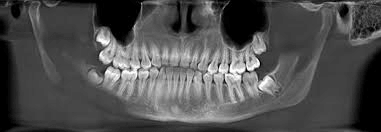 CT scan of the jaw: a horizontally positioned lower wisdom tooth exerts pressure on the adjacent seventh tooth and requires careful segmental removal of the crown during extraction.
Once the teeth have been carefully extracted, the healing process begins. And here, the way in which the surgeon concludes the surgery plays a crucial role.
CT scan of the jaw: a horizontally positioned lower wisdom tooth exerts pressure on the adjacent seventh tooth and requires careful segmental removal of the crown during extraction.
Once the teeth have been carefully extracted, the healing process begins. And here, the way in which the surgeon concludes the surgery plays a crucial role.
A real-life day-by-day recovery timeline
At the end of the surgery, the surgeon always places stitches in each socket. Stitches are necessary not only because the wound was large; they hold the blood clot in the socket, protect it from food debris and bacteria, and help the gum margins close quickly. Thanks to the stitches, the patient feels more comfortable in the first few days, as the wound is closed. Standard recovery after surgery is predictable and divided into several stages. Day one Immediately after the surgery, it is recommended to apply a cold compress to the outside of the cheek for ten to fifteen minutes at a time, with breaks in between. This helps to reduce future swelling. Food on this day should be cool and soft — purées, yoghurts, smoothies. Hot dishes and hard foods are strictly prohibited to prevent damage to the stitches or bleeding. Day Two Swelling begins to appear in the cheeks. This is a normal vascular reaction to the surgical procedure. Most patients notice the so-called ‘cute hamster’ effect, where the cheeks become slightly rounded, but they generally feel well and experience very little pain. Day Three This is when the swelling is at its peak. The cheeks may become quite swollen, making it harder to open the mouth wide and chew. On this day, discomfort may be at its most pronounced, so taking the painkillers prescribed by the surgeon is essential. Day Four and onwards The swelling begins to subside gradually, it becomes easier to open the mouth, and life returns to normal. Within a week, the stitches are removed or dissolve on their own if a special material was used, and the patient completely forgets that they ever had wisdom teeth. The peak of soft tissue swelling (‘hamster effect’) naturally occurs on the third day after extraction, after which the swelling subsides rapidly.
The rule of thumb for a successful recovery is to strictly follow the dentist’s instructions, avoid vigorous mouth rinsing to prevent washing away the protective clot, and take the prescribed anti-inflammatory medication as directed, without waiting for acute pain to set in. But before planning the procedure, it is essential to determine whether these teeth really need to be removed.
The peak of soft tissue swelling (‘hamster effect’) naturally occurs on the third day after extraction, after which the swelling subsides rapidly.
The rule of thumb for a successful recovery is to strictly follow the dentist’s instructions, avoid vigorous mouth rinsing to prevent washing away the protective clot, and take the prescribed anti-inflammatory medication as directed, without waiting for acute pain to set in. But before planning the procedure, it is essential to determine whether these teeth really need to be removed.
When is it really necessary to remove wisdom teeth?
We do not recommend removing wisdom teeth ‘just because’ if they have erupted straight, do not interfere with neighbouring teeth and are easy to clean as part of your daily oral hygiene routine. However, in most cases, the reasons for removal are clearly clinical. Orthodontic reasons Wisdom teeth take up a lot of space in the jaw. If there is not enough space, they begin to exert pressure on the entire dental arch, causing crowding of the front teeth. Before fitting braces or clear aligners, the removal of wisdom teeth is a mandatory step to create space for the proper movement of the remaining teeth and to ensure stable results after treatment. Surgical and therapeutic indications Due to their remote location, wisdom teeth are difficult to clean properly with a toothbrush. Plaque builds up on them quickly, leading to tooth decay. Furthermore, if a wisdom tooth is tilted towards the adjacent seventh tooth, food constantly gets stuck in the gap between them. This leads to the development of caries on the root of the seventh tooth, which is very difficult to treat and often results in the loss of both teeth. Another indication is constant biting and trauma to the cheek. Despite all the advantages of extraction under sedation, there are a number of standard contraindications to sedation, which the anaesthetist will always assess during the preliminary consultation. These include individual intolerance to sedatives, acute mental illnesses in the acute phase, severe decompensated diseases of the cardiovascular or respiratory systems, as well as acute infectious diseases such as influenza or acute respiratory viral infections. In all other cases, sedation is a completely safe, comfortable, and predictable way to resolve the issue of wisdom teeth once and for all.Learn more about the services related to this topic. Below, you’ll find detailed information about the relevant treatment methods and options.
Teeth extraction under sedation
Sedation dentistry (sleep dentistry)




 Our team
 Reviews
 Blog
Blog News
News Partners
 FAQ
FAQ Vacancies
 Dental Consultation
 Tooth Decay Treatment
 Root canal treatment under a microscope
 Orthodontics
 Dental Implants
 Dental Prosthetics
 Professional Oral Hygiene
 Tooth Filling
 Periodontal disease treatment
 Aesthetic Dental Restoration
 Teeth extraction
 Surgical dentistry
 Sedation dentistry (sleep dentistry)