


Automatically translated by Google

Reviews are sourced from Google. Some reviews may be automatically translated and are displayed without editorial changes.
Automatically translated by Google

Automatically translated by Google

Automatically translated by Google

Automatically translated by Google

Automatically translated by Google

Automatically translated by Google

Automatically translated by Google

Automatically translated by Google

Automatically translated by Google
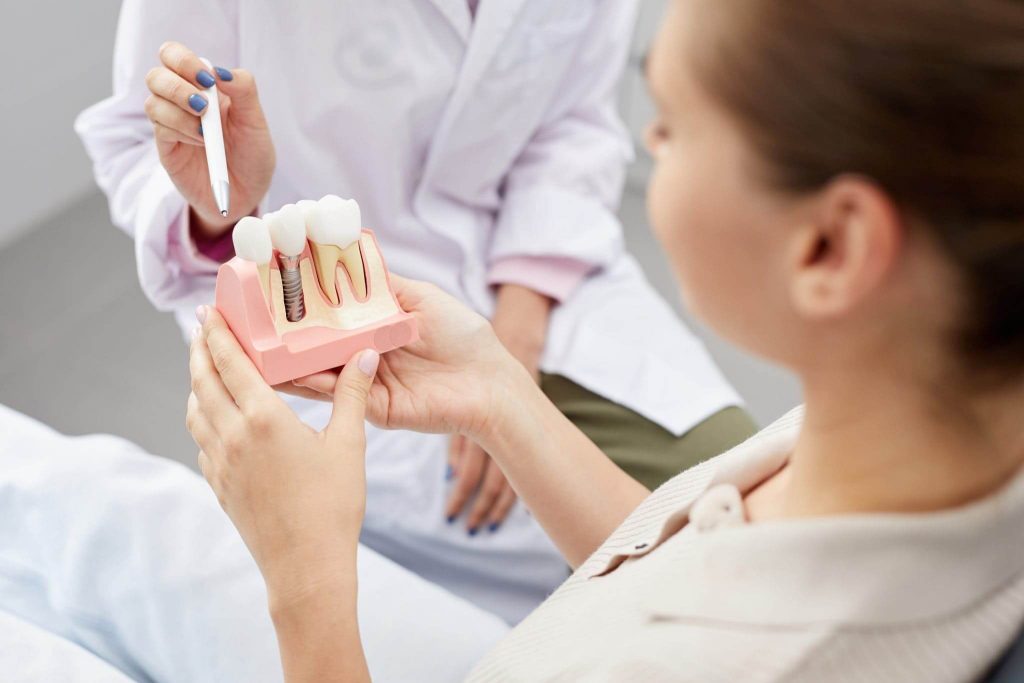
A dental implant is an artificial construction that replaces the root of a missing tooth; it is anchored in the upper or lower jaw’s bone tissue. Dental implantation can serve as a support for crowns, as well as removable and fixed restorations.
Dental implants are the most natural-looking replacement for healthy, natural teeth. They allow living the life you want – to eat with confidence, smile, laugh, talk and enjoy all your daily activities without worrying about your teeth.

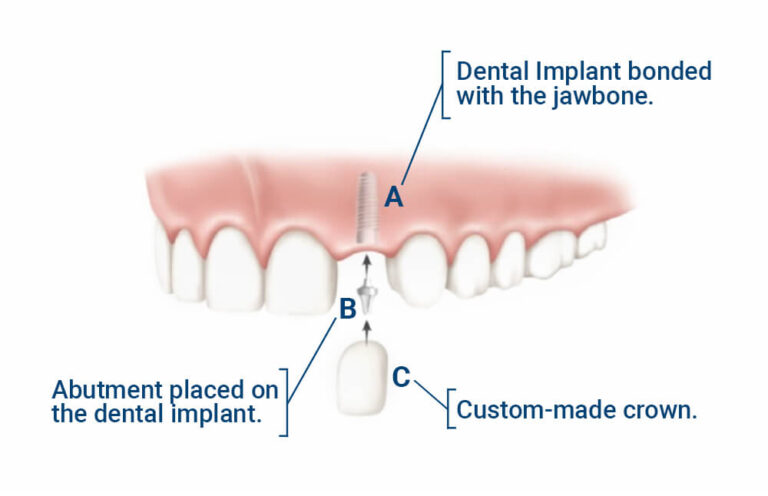
When dental implants are placed in the jawbone (A), they fuse with your natural bone and become a solid foundation to support one or more artificial teeth called crowns.
Abutment (B) – Placed over a dental implant to support your crowns. Crowns are made in a dental laboratory using previously taken impressions (C).


 (474)
(474)
 (672)
(672)
One of our patients, whose all 5 implants survived and still function properly, is 84 years old. This age is absolutely normal for treatment in European countries if the patient has no contraindications for implantation.
We place implants in 6-8 weeks or 4 months after tooth extraction, depending on the bone volume loss.
The success rate after implant surgery is over 99%. With proper care and regular oral hygiene routine that we tailor after implantation, they can last a lifetime.
An implant is a great solution when a single tooth or posterior teeth are missing, with complete loss of teeth in the upper and lower jaws.
It doesn’t hurt more than any other dental treatment. Implant surgery is performed under local anesthesia; it can also be performed under sedation (a sleep-like state) or general anesthesia optionally and due to medical reasons.
Official statistics indicate that a correctly placed implant survives in 98.5% of cases. Based on many years of experience in implant therapy, we give 98-99%.
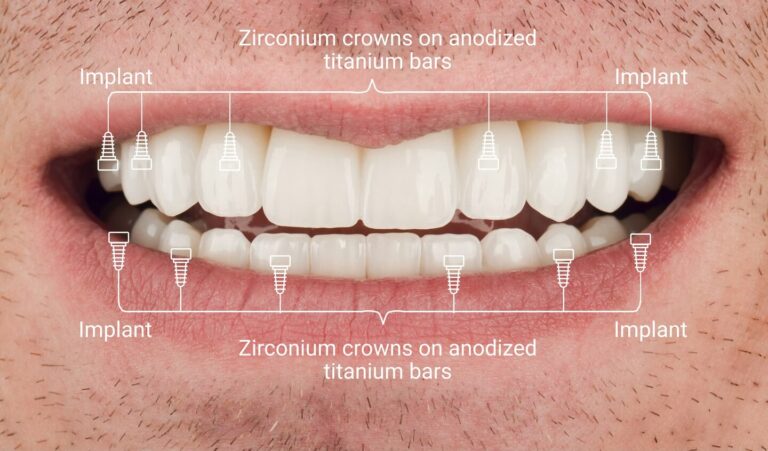
With a single missing tooth – 1 implant, with the loss of posterior teeth – 2-3 implants, with an edentulous upper or lower jaw – 4 implants per bar overdenture or 6-8 implants per fixed denture.
Today, surgical navigation systems allow conducting implant surgery without incision using 3D modeling.
All-on-4 requires at least a minimum amount of bone in the front of the jaw to place two front implants. Maxilla-For-All works even in the complete absence of bone.
Cheekbone implants can last a lifetime because the cheekbone does not resorb. The prosthesis attached to them may need to be replaced in 10-15 years due to natural wear and tear, but the implants themselves remain in place.
No. The placement of cheek implants requires a highly skilled surgeon; with careful planning and 3D navigation, procedural risks can be substantially reduced.
No, the surgery is performed under sedation.






 Our team
 Reviews
 Blog
Blog News
News Partners
 FAQ
FAQ Vacancies
 Dental Consultation
 Tooth Decay Treatment
 Root canal treatment under a microscope
 Orthodontics
 Dental Implants
 Dental Prosthetics
 Professional Oral Hygiene
 Tooth Filling
 Periodontal disease treatment
 Aesthetic Dental Restoration
 Teeth extraction
 Surgical dentistry
 Sedation dentistry (sleep dentistry)