


Dental implantation

Price of Dental Implants
· “Alpha-Bio” implant;
· gum former;
· abutment;
· zirconia crown with screw fixing.
· “JDental” implant;
· gum former;
· abutment;
· zirconia crown with screw fixing.
What is an Implant?
A dental implant is an artificial construction that replaces the root of a missing tooth; it is anchored in the upper or lower jaw’s bone tissue. Dental implantation can serve as a support for crowns, as well as removable and fixed restorations.
Dental implants are the most natural-looking replacement for healthy, natural teeth. They allow living the life you want – to eat with confidence, smile, laugh, talk and enjoy all your daily activities without worrying about your teeth.

Stages of Implantation
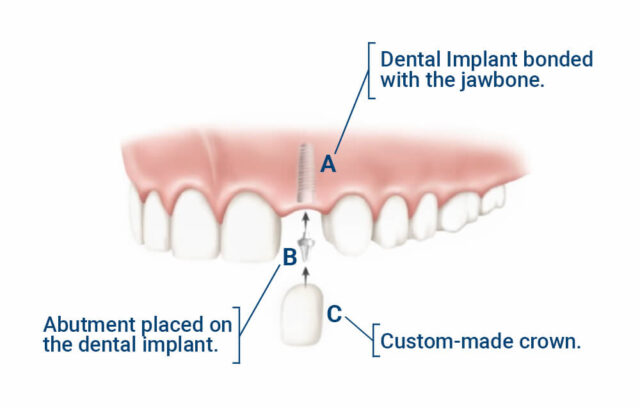
When dental implants are placed in the jawbone (A), they fuse with your natural bone and become a solid foundation to support one or more artificial teeth called crowns.
Abutment (B) – Placed over a dental implant to support your crowns. Crowns are made in a dental laboratory using previously taken impressions (C).


Reviews


FAQ
Is there an age limit implant surgery?
One of our patients, whose all 5 implants survived and still function properly, is 84 years old. This age is absolutely normal for treatment in European countries if the patient has no contraindications for implantation.
How soon after tooth extraction can you have an implant?
We place implants in 6-8 weeks or 4 months after tooth extraction, depending on the bone volume loss.
Can implants last a lifetime?
The success rate after implant surgery is over 99%. With proper care and regular oral hygiene routine that we tailor after implantation, they can last a lifetime.
What are the indications for dental implant treatment?
An implant is a great solution when a single tooth or posterior teeth are missing, with complete loss of teeth in the upper and lower jaws.
Does dental implant surgery hurt?
It doesn’t hurt more than any other dental treatment. Implant surgery is performed under local anesthesia; it can also be performed under sedation (a sleep-like state) or general anesthesia optionally and due to medical reasons.
What are medical contraindications to implant therapy?
The main absolute contraindication to implant therapy is radiotherapy. Relative contraindications can be osteoporosis, diabetes mellitus, thyroid diseases, nervous and mental diseases, severe cardiovascular diseases.In these cases, the question of implant therapy is considered individually.
How often do dental implant fail?
Official statistics indicate that a correctly placed implant survives in 98.5% of cases. Based on many years of experience in implant therapy, we give 98-99%.
What if the patient is allergic to the implant material?
According to the German Association of Oral Implantology, an allergy to titanium, from which the implant is made, occurs in one out of 10,000 patients. In this case, we can carry out the LTT (Lymphozyten Transformation) allergy test.
If titanium allergy is confirmed, we recommend using the less popular but effective zirconium implants.
How many implants do I need?
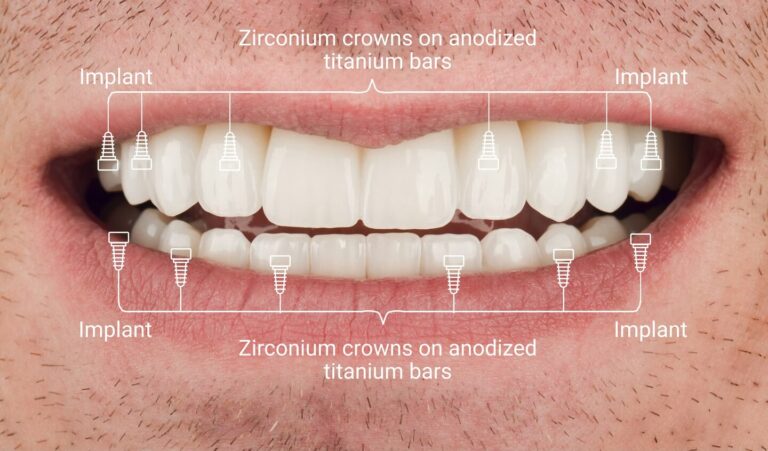
With a single missing tooth – 1 implant, with the loss of posterior teeth – 2-3 implants, with an edentulous upper or lower jaw – 4 implants per bar overdenture or 6-8 implants per fixed denture.
What is the latest technology in dental implants?
Today, surgical navigation systems allow conducting implant surgery without incision using 3D modeling.

 Out team
 Reviews
 Blog
Blog News
News Price list
 Partners
 FAQ
FAQ Vacancies
 Dental Consultation
 Tooth Decay Treatment
 Root canal treatment (endodontics)
 Orthodontics
 Dental implantation
 Dental prosthetics
 Professional oral hygiene
 Tooth Filling
 Periodontal disease treatment
 Teeth restoration
 Teeth extraction
 Surgical dentistry
 Sedation dentistry (sleep dentistry)