


 (210)
(210)


Restrictions must be observed after dental implants to ensure that rehabilitation is quick, easy, and without complications. One of the main recommendations is refusing sports and other physical activities. But do not be frightened; the restriction applies only in the first weeks after the procedure. After completing the recovery period, you can lead a usual active life.
In this article, you will learn how much you can not do sports after dental implants and how to return to the training routine properly.

Recovery Periods After Implants
Rehabilitation after implant placement is a long process that ends with the complete fusion of the structure with the bone (osseointegration). This will take on average 2-6 months. It all depends on the type of surgery, the type of implant, the initial state of bone tissue, and the general state of health of the patient.
Restrictions must be observed throughout the recovery period. The severity of these prohibitions is determined by the doctor individually and varies at different stages of rehabilitation.
Early postoperative stage
For 10-14 days after a dental implant is placed, physical activity and sports are prohibited. At this time, the body needs rest and a gentle regimen so that the healing of tissues in the oral cavity passes quickly and without unpleasant consequences.
The duration of strict restrictions depends on the type of surgery. In one-stage implantation, which is carried out through a puncture, the surrounding tissues are practically not damaged, so regeneration is faster.
After such a procedure, many patients recover in 7-10 days. If complex implant placement was performed, for example, in the absence of teeth on the jaw or bone atrophy, the early rehabilitation period takes at least 2 weeks.
During this period, it is recommended that the patient:
- Avoid aerobic and anaerobic exercise;
- Avoid running, fast walking, and other activities;
- Avoid swimming;
- Avoid exhausting physical work;
- Do not lift heavy weights.
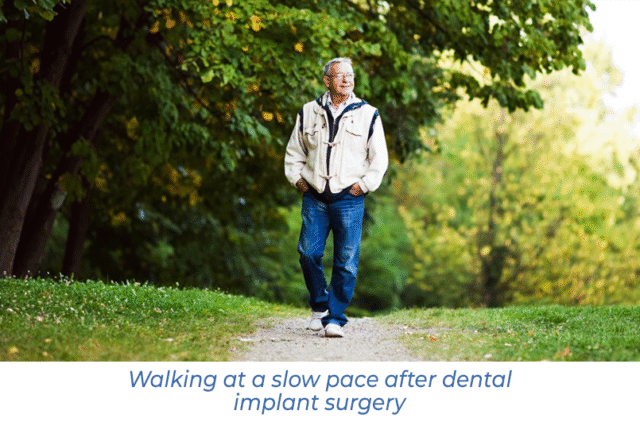
If the patient ignores the doctor’s recommendations, there may be unpleasant consequences: severe and prolonged post-surgical swelling, bleeding from the wound, suture separation, and intense pain in the jaw. Physical activity increases the length of the rehabilitation period and increases the risk of complications, including displacement or rejection of the implant.
Transition to moderate exercise
Two weeks after surgery, the transition phase begins, when the restrictions become less strict. By this time, pain and postoperative swelling disappear, the sutures are removed, and primary healing of tissues in the oral cavity occurs.
Patients feel well and can gradually return to daily life. However, rehabilitation is incomplete, so too intense exercise may cause complications.
During the transition phase, the following types of physical activity are permitted:
- Walking at a relaxed or brisk pace;
- Stretching exercises;
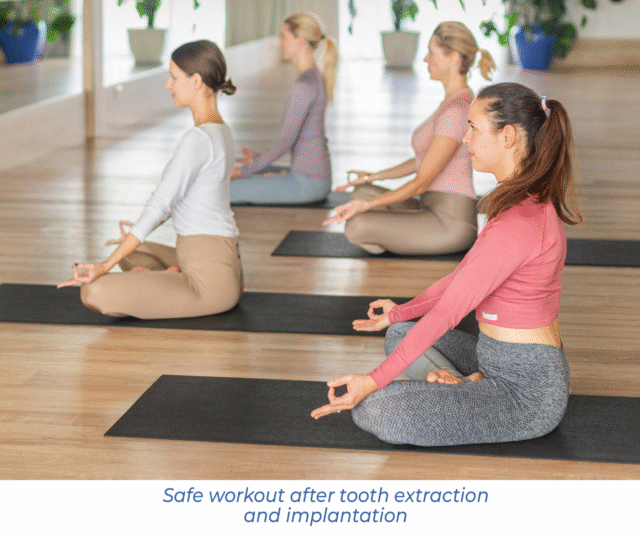
- Yoga and Pilates exercises at a slow pace;
- Light exercises for muscles and joints.
During these workouts, the patient should monitor heart rate and general health, avoid overexertion, and reduce the number of repetitions and the total time of exercise.
During the transition period, all forms of strength training, running, and other aerobic exercises are prohibited. Contact sports, jumping, and any exercise that tilts the head downward are also prohibited.
Return to working out
A month after dental implant surgery, the list of acceptable loads is significantly expanded. With the doctor’s permission, you can go swimming, dancing, yoga, gym training, and jogging at a moderate pace. Cycling, Nordic walking, and skiing are also allowed. At this time, a person can lead an active life.
However, some sports will have to be postponed for 2 months, until the implant fully stabilises in the bone. These include:
- Sports games (football, volleyball, hockey);
- All types of wrestling and boxing;
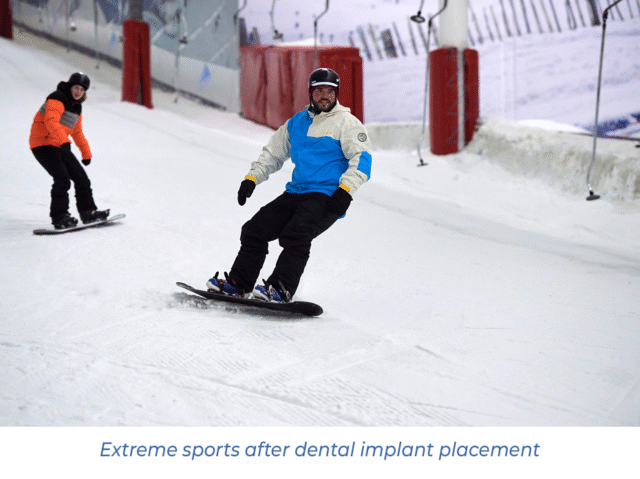
- Extreme sports (mountaineering, snowboarding, kite surfing);
- Weightlifting.
Before beginning heavy lifting, the doctor must ensure that the implant is fully engrafted and that a stable treatment result has been achieved. The dentist and sports medicine physician determine the exact period when it is possible to return to sports after dental implants.
Effect of Different Sports on the Healing Process
The risks of all types of sports training are related to the following factors:
- Increased heart rate and blood pressure, resulting in increased tissue swelling, increased possibility of bleeding;
- Involuntary clenching of the jaw during heavy loads, which may result in wound trauma and displacement of the dental implant;
- Injuries to the jaw as a result of a hit or fall.
Contact sports are recognised as the most dangerous. They combine all factors that negatively affect healing. Combat sports and team games put a great strain on the organism and are also associated with a high probability of injuries due to being hit by a ball or by a sparring partner.
Skating, skiing, snowboarding, and other extreme entertainment are no less dangerous. They often lead to falls and injuries to the maxillofacial region, which can cause the dental implants to shift.
Many patients ask why you can’t run after dental implants. When running, the body and head are in constant motion, which negatively affects the stability and speed of implant healing. In addition, the load requires a lot of tension and is accompanied by increased work of the cardiovascular system, resulting in possible bleeding and swelling of the jaw.
Recommendations for preventing complications
Most of the negative consequences, such as bleeding, peri-implantitis, and prolonged wound healing, are related to the violation of the rules of the rehabilitation period.
To avoid such complications, you must follow the doctor’s instructions. At the consultation, the dentist will tell you in detail what is not allowed after tooth extraction and implant placement. The main recommendations are:
- Until the pain and swelling disappear, eat only soft food and try to chew on the opposite side of the jaw;
- Carefully perform oral hygiene without traumatising the implant area;
- Do not touch the surgery area with your hands or tongue;
- Sleep on your back or opposite side;
- Avoid overheating and hypothermia;
- Avoid smoking and alcohol.
After implant surgery, the dentist usually prescribes antibiotics to prevent complications and medication to reduce uncomfortable postoperative symptoms.
The medication should be taken strictly according to the schedule and not stopped before the specified time. It is also necessary to rinse the mouth with antiseptic solutions that prevent bacterial infections and inflammation.
When should I see a doctor?
A follow-up visit to the dentist is necessary in case of complications of the rehabilitation period, which may be manifested by:
- heavy bleeding from the implant area;
- pus discharge from the wound;
- pain in the jaw for more than 10 days after surgery;
- intense swelling that does not go down or even increases over time;
- increased body temperature;
- generalised malaise.
An emergency visit to the doctor will be required in case of jaw trauma. This is a dangerous situation, which is likely to result in rejection or loss of the dental implant, damage to the maxillary sinus wall, and injury to the trigeminal nerve. Even if the impact is minor, there is no bleeding and no signs of fracture, you should see a dentist immediately.




 Out team
 Reviews
 Blog
Blog News
News Price list
 Partners
 FAQ
FAQ Vacancies
 Dental Consultation
 Tooth Decay Treatment
 Root canal treatment (endodontics)
 Orthodontics
 Dental implantation
 Dental prosthetics
 Professional oral hygiene
 Tooth Filling
 Periodontal disease treatment
 Teeth restoration
 Teeth extraction
 Surgical dentistry
 Sedation dentistry (sleep dentistry)