


 (12)
(12)
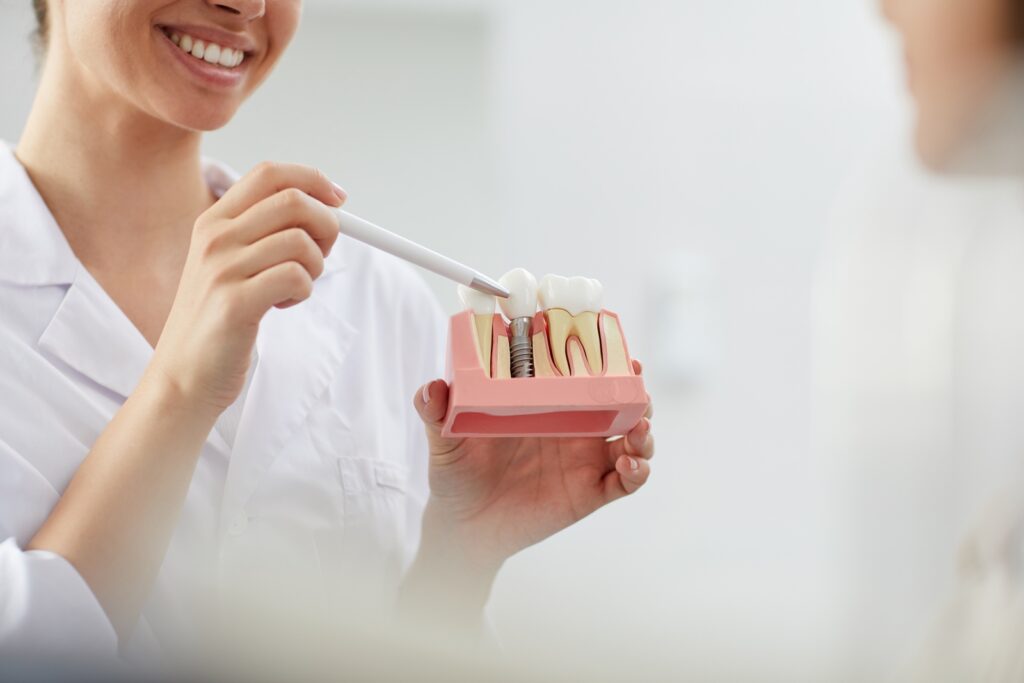
When many teeth are lost, it is not only the smile that changes. A person starts chewing differently. Sometimes they avoid hard foods. Speech may change, discomfort may appear in the jaw joint, and the remaining teeth take on excessive load.
There is another important point: bone tissue. Where teeth have been missing for a long time, the bone gradually loses volume. The patient does not see this in the mirror, but the dentist clearly sees it during diagnostics.
That is why tooth restoration should not be postponed for years. But then another question appears: what exactly should be chosen?
During consultations, patients often say something like this:
“I have read about implants, All-on-4, All-on-6, and dentures. But I do not understand which of these is right for me.”
This is a normal question. There really are many options. The choice depends not on the name of the method, but on the specific situation in the mouth: how many teeth are missing, which teeth can still be preserved, the condition of the bone, gums, and bite, and whether there were previous crowns, bridges, or removable dentures.
In this article, we will review the main tooth restoration options and explain when a dentist may consider implants, All-on-4, All-on-6, Maxilla-For-All, or prosthetic treatment.
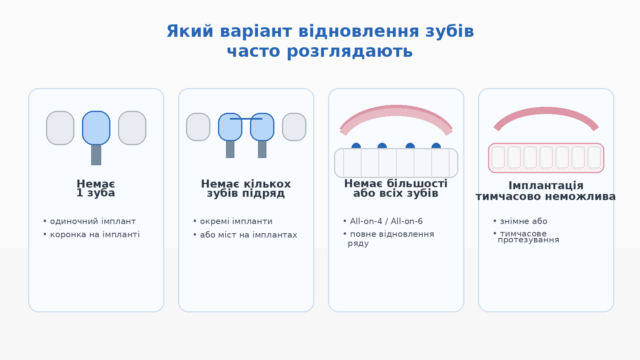
Source: prepared for the article
If one or several teeth are missing
When one tooth is missing, classic dental implantation is most often considered.
An implant works as an artificial root. After placement and integration, a crown is fixed on it. As a result, one separate tooth is restored, and the neighboring healthy teeth do not need to be prepared for a bridge.
This is important, especially if the adjacent teeth are vital, strong, and do not have large fillings.
Implants are also used when several teeth in a row are missing. In this situation, the dentist evaluates whether it is better to place separate implants with crowns or to plan a bridge-like restoration supported by implants.
Diagnostics are mandatory before treatment. Usually, a CBCT scan is needed. It shows bone volume, jaw anatomy, the position of neighboring teeth, and helps determine whether an implant can be placed in the correct position.
During the appointment, the dentist does not simply check whether “there is space or not.” The dentist evaluates whether the future tooth will withstand the load and whether it will fit into the overall bite.
If most teeth or all teeth are missing
When many teeth are missing, the approach is different. Placing an implant for every lost tooth is usually not necessary. And often, it is not the best solution.
Here we are talking about comprehensive restoration of the dental arch.
The dentist may consider:
- All-on-4;
- All-on-6;
- Maxilla-For-All;
- implant-supported prosthetic treatment;
- removable or conditionally removable prosthetic treatment.
The goal of such treatment is not simply to “put in teeth.” It is necessary to restore normal chewing, make the restoration stable and comfortable, restore bite height, and recreate a natural-looking smile.
The patient should not only see teeth in the mirror. The patient should be able to use them.
What is All-on-4?
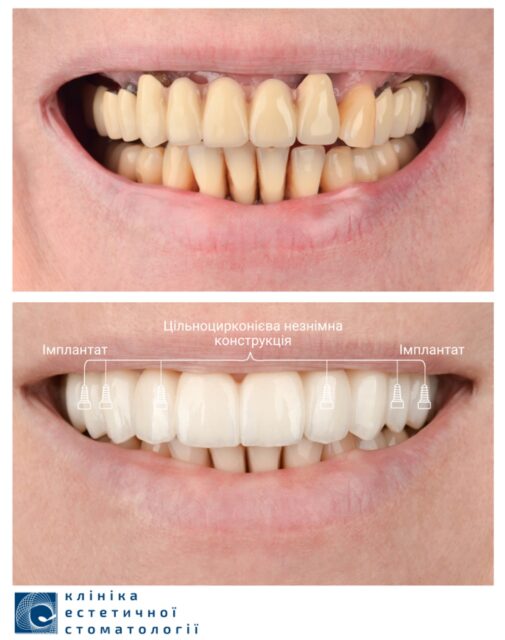
All-on-4 is a method of restoring a dental arch when a fixed restoration is supported by 4 implants.
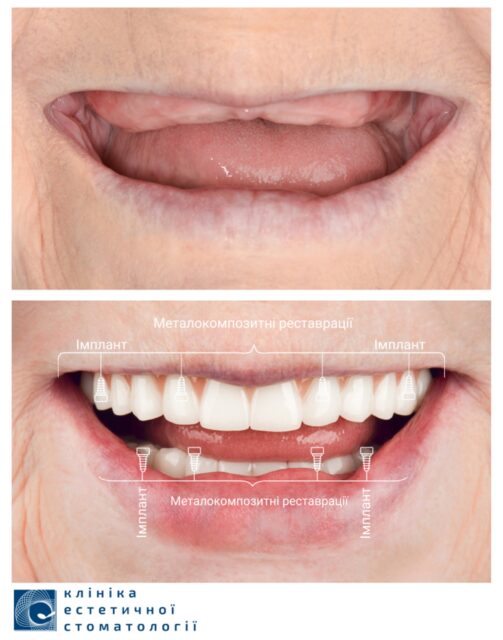
This option is most often discussed when all or almost all teeth are missing in one jaw. Or when teeth are still present, but some of them no longer have a good prognosis.
Many patients come to All-on-4 after experience with a removable denture. It may not hold well, may rub, interfere with chewing, or simply feel psychologically unsuitable for the person.
All-on-4 is chosen when there are conditions for placing 4 implants and planning a fixed restoration on them. This does not mean that the method is suitable for everyone. The dentist must assess bone tissue, bite, load, and the position of the future implants.
During the consultation, this often sounds like: “First we will look at the CBCT scan, and then we will discuss whether four supports are enough.”
Learn more: All-on-4 dental implants at KES
What is All-on-6?
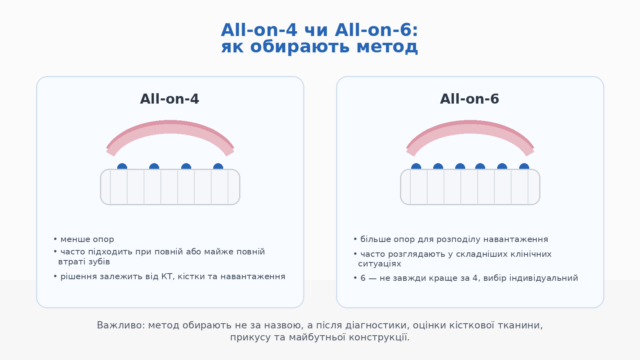
All-on-6 is restoration of a dental arch on 6 implants.
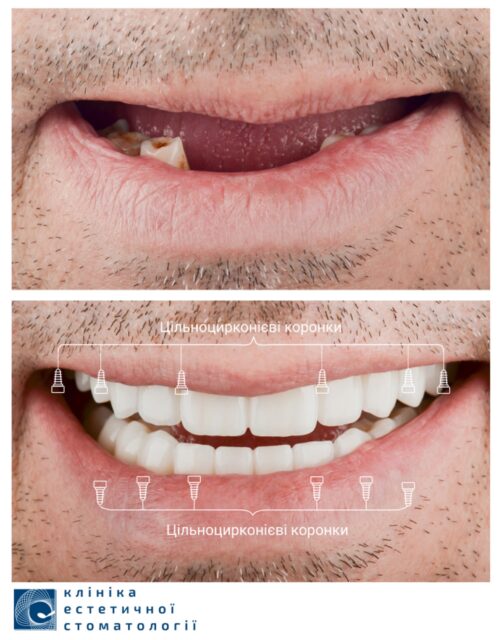
Here, there are more supports. This is important when chewing load needs to be distributed more effectively, when the clinical situation is more complex, or when the dentist is planning long-term comprehensive restoration.
All-on-6 is often considered when all or almost all teeth are missing in a jaw, if there are conditions for placing 6 implants and the patient needs a stable fixed restoration.
But it is not correct to think that 6 is always better than 4. Dentistry does not work that way.
In one case, 4 implants are enough. In another, 6 may be a better plan. And sometimes preparation is needed before implant placement: tooth extraction, treatment of inflammation, bone grafting, or other stages.
Source: prepared for the article
Learn more: All-on-6 dental implants at KES
All-on-4 or All-on-6: how the method is chosen
At first glance, the difference seems simple: All-on-4 means 4 implants, and All-on-6 means 6 implants. But for the dentist, this is not just a number in the name.
It matters exactly where the implants can be placed. Whether there is enough bone tissue. How the bite works. What load the restoration will carry. What the future prosthetic restoration should be like.
A patient may come with a clear wish: “I want All-on-4.” After diagnostics, the dentist may see that All-on-6 would be more reliable. The opposite can also happen: a person expects a complex plan, while the situation allows a less extensive treatment.
That is why CBCT diagnostics and consultation are not a formality. This is the stage where it becomes clear which method makes sense and which is better not to choose.
When removable prosthetic treatment may be needed
Removable dentures also remain an option for tooth restoration. Sometimes they are temporary. Sometimes they are permanent, if implantation is not possible or if the patient is not yet ready for surgical treatment.
For example, a removable denture may be offered during the preparation period before implantation. Or when teeth need to be restored quickly while the main treatment is still ongoing.
There are other reasons as well: medical contraindications, budget limitations, or the need for a temporary restoration before permanent prosthetic treatment.
However, removable prosthetic treatment has its limitations. A denture may require adaptation. Sometimes it rubs, affects speech, or does not provide a sense of stability during chewing.
That is why, when many teeth are missing, the dentist often suggests considering implant-supported prosthetic treatment. It usually provides more stability and comfort, if the conditions allow it.
What is implant-supported prosthetic treatment?
Implant-supported prosthetic treatment is not a “secondary” stage after implantation. It is part of one plan.
Implants create support. The prosthetic restoration is what the patient lives with every day. It determines the shape of the teeth, their color, the bite, chewing comfort, and the appearance of the smile.
That is why teamwork is important in complex tooth restoration. The implant surgeon plans implant placement. The prosthodontist plans the future restoration.
These stages should not exist separately.
First, it is necessary to understand what result we want to achieve: where the teeth will be, how they will meet, and how the load will be distributed. Only then is the implant position planned for that result.
Learn more: prosthetic treatment at KES
Why you should not choose the method on your own
Reading about All-on-4, All-on-6, implants, or removable dentures is useful. It helps the patient better understand the possibilities of modern dentistry.
But the final decision is not made based on an online description.
During the consultation, the dentist evaluates several things at the same time: how many teeth are missing, which teeth can still be preserved, whether there is inflammation, the condition of the bone tissue, how the bite works, and whether there were previous crowns, bridges, or dentures.
Another important question is what result the patient expects.
Some people need the most stable fixed solution possible. Others need a temporary option before the main treatment. Others first need bone preparation or treatment of inflammation.
CBCT helps show what cannot be seen during a regular examination: bone volume, anatomical features, the location of important structures, and the real possibilities for implant placement.
Without such diagnostics, it is impossible to honestly say what is best in your specific situation: All-on-4, All-on-6, separate implants, a removable denture, or another restoration option.
If teeth are still present, but they are in poor condition
This is a separate and very common situation.
Teeth are still present, but some of them are mobile, destroyed, inflamed, or cannot serve as reliable support for the future restoration. In this case, the patient often does not understand whether these teeth should be preserved or extracted.
The correct answer appears after diagnostics.
It is not always necessary to extract everything immediately. Sometimes some teeth can be treated and included in the overall plan. But there are cases when trying to preserve weak teeth only complicates treatment and worsens the prognosis of the future prosthetic restoration.
The dentist evaluates not only the condition of a separate tooth. The dentist looks at whether this tooth will be useful in the overall restoration.
In complex cases, several specialists may be involved in planning: a surgeon, prosthodontist, endodontist, periodontist, or orthodontist. This does not mean that the treatment will necessarily be complicated. It means that the plan must be well thought out.
What determines the cost of tooth restoration
The cost of treatment depends not only on the number of implants.
The cost is influenced by the number of missing teeth, the chosen method, the implant system, the need for tooth extraction, bone grafting, or sinus lift. It also matters which restoration will be temporary and which will be permanent.
The materials of the future teeth, the complexity of the bite, and the number of treatment stages are also important.
Therefore, two patients with the same phrase “I want to restore my teeth” may receive different plans. One may be suitable for single implant placement. Another may need All-on-4. A third may need All-on-6 or full rehabilitation with preparatory stages.
An accurate cost can be given only after consultation and diagnostics. Otherwise, it will not be a treatment plan, but an approximate guess.
How to roughly understand which option may be suitable
There is a simple logic that helps provide orientation.
If one tooth is missing, a single implant with a crown is often considered.
If several teeth in a row are missing, separate implants with crowns or a bridge-like restoration on implants may be possible.
If almost all teeth in a jaw are missing, the dentist considers All-on-4, All-on-6, or other options for full dental arch restoration.
If implantation is temporarily not possible, a removable or temporary prosthetic solution may be used.
But this is only a guideline. It is not a diagnosis and not a ready-made plan. The real decision is always created individually.
Start with a consultation and CBCT diagnostics. The dentist can then determine which teeth may be preserved and which restoration option can provide a stable result.
Frequently asked questions
Where should I start if many teeth are missing?
Sometimes yes, depending on the anatomy. Some cases require bone grafting, while others may allow a protocol that uses the available bone volume.
Can implants be placed if there is little bone?
No. When many teeth are missing, bridge-like or full-arch restorations can often be supported by a smaller number of implants.
Is an implant needed for every missing tooth?
There is no universally better option. The number of implants depends on anatomical conditions, bone volume, bite, and the design of the future restoration.
Which is better: All-on-4 or All-on-6?
In some clinical situations, yes. However, All-on-4 is selected only after CBCT diagnostics and assessment of bone tissue, bite, and expected load.
Conclusion
If many teeth are missing, the best place to start is not choosing the name of a method, but diagnostics.
You do not need to decide on your own that you definitely need All-on-4, All-on-6, or a removable denture. It is better to first understand what is happening with the bone tissue, which teeth can still be preserved, how the bite works, and what kind of restoration can be made stable in your specific situation.
This saves time. And it often helps avoid wrong decisions.
At KES, we start with consultation and diagnostics. The dentist assesses the situation, explains possible options, compares their advantages and limitations, and prepares an individual treatment plan.
Book a consultation at KES — we will help you understand which tooth restoration option is right for you.





 Our team
 Reviews
 Blog
Blog News
News Partners
 FAQ
FAQ Vacancies
 Dental Consultation
 Tooth Decay Treatment
 Root canal treatment under a microscope
 Orthodontics
 Dental Implants
 Dental Prosthetics
 Professional Oral Hygiene
 Tooth Filling
 Periodontal disease treatment
 Aesthetic Dental Restoration
 Teeth extraction
 Surgical dentistry
 Sedation dentistry (sleep dentistry)