


 (15)
(15)

Before placing a dental crown or starting prosthetic treatment, the dentist looks not only at the shape of the tooth. It is important to understand what is happening inside.
Sometimes a tooth looks calm. It does not hurt. It does not react to cold. The patient chews normally and is genuinely surprised when, after diagnostics, they hear: “Before the crown, it is better to treat the canals.”
This is a common situation.
During the appointment, we usually explain it this way: if a tooth does not hurt, it does not always mean that everything is fine inside. Inflammation near the root sometimes causes no acute symptoms and becomes visible only on an X-ray or CBCT scan. If a crown or bridge is fixed on such a tooth right away, the problem may appear after the prosthetic work has already been completed.
Then treatment becomes more complicated. Sometimes the new restoration has to be removed, the canals retreated, and only then can the prosthetic stage be resumed.
That is why, before placing a crown, it is important to check not only the “external” part of the tooth, but also the roots, canals, and surrounding tissues.
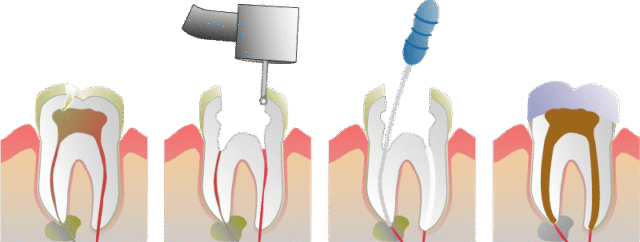
Source: Wikimedia Commons.
Why canals may need treatment before a crown
Inside the tooth is the pulp — blood vessels and nerve fibers. If decay was deep, if there was an old large filling, trauma, a crack, or inflammation, infection may have entered the canals.
Sometimes this is obvious right away. The tooth hurts, reacts to cold or hot, and it is unpleasant to press on it or chew.
But it can also be different: the person feels nothing, while the image shows changes near the tip of the root. For the patient, this is unexpected. For the dentist, it is a signal that the cause needs to be addressed before prosthetic treatment.
Before placing a crown, the dentist checks whether the tooth is vital, whether the canals were treated previously, and whether there is inflammation near the root. It is also important to assess old fillings, the amount of remaining tooth structure, and whether the tooth will be able to withstand the future load.
If the canals have already been treated before, the quality of that treatment is evaluated. The canals must be negotiated, cleaned, and filled in a way that leaves no infection inside.
Learn more: root canal treatment at KES
When root canal treatment before a crown is needed
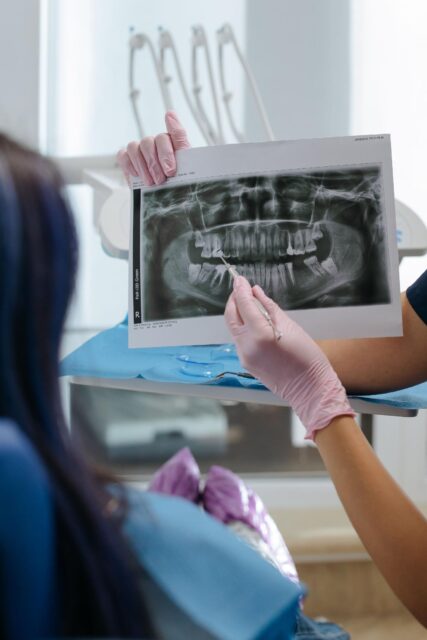
Source: Pexels, cottonbro studio.
Canals are treated before a crown when the tooth has deep decay, inflammation of the nerve, or changes near the root.
Another common reason is an old large filling. From the outside, it may seem that the tooth simply needs a crown because little tooth structure remains. But there may be recurrent decay under the filling, or the filling may be very close to the pulp. In this situation, the dentist evaluates whether the tooth can be prepared without endodontic treatment or whether the canals still need to be treated.
A separate case is teeth that have already been treated before.
If previous endodontic treatment was performed poorly, the canals often need retreatment before a new crown. For example, they may not be filled to the full length, there may be voids, infection may remain, or the image may show an inflammatory process in the bone tissue.
Root canal treatment before a crown is most often needed when:
- the tooth is severely damaged;
- there is deep decay;
- an old filling occupies a significant part of the tooth;
- the tooth hurts or reacts to temperature;
- there is pain when biting;
- the image shows inflammation near the root;
- the canals were treated before, but need retreatment;
- the tooth changed color after previous treatment;
- a crown, bridge, or complex prosthetic treatment is planned.
Important point: canals are not treated “just in case” for every patient before a crown. If the tooth is vital, has no inflammation, and has enough remaining structure, a crown can be placed without removing the pulp.
Is it always necessary to remove the nerve before a crown?
No.
In the past, patients often heard: “It is better to remove the nerve before placing a crown.” The modern approach is different. If the tooth can remain vital and the conditions allow it, the pulp is not removed unnecessarily.
A vital tooth has natural nourishment and sensitivity. This is valuable.
But the pulp cannot always be preserved. If decay is deep, if there is inflammation, pain, changes on the image, or a high risk of complications after tooth preparation, the dentist explains to the patient why endodontic treatment is needed.
Here, the key factor is not the crown itself, but the condition of the specific tooth.
During the consultation, the dentist reviews images, the depth of the lesion, the amount of future preparation, the quantity of healthy tissue, and the role of this tooth in the future restoration. One tooth can be prepared for a crown while remaining vital. Another must be treated first. And if a tooth is destroyed too deeply or has a poor prognosis, it should not be used as an abutment.
Why high-quality root canal treatment matters

Source: Pexels, MM Dental.
Retreatment of root canals before prosthetic treatment
Before placing a crown, the dentist often deals not with primary treatment, but with retreatment of root canals.
A typical situation: a patient has had an old filling or crown for many years. The tooth did not hurt. The person came to replace the restoration, but the image shows that the canals were not filled to the full length or that there is inflammation near the root.
Simply placing a new crown in such a case is risky.
Retreatment is needed when previous treatment is incomplete, infection remains in the canals, there is inflammation near the root apex, or decay has appeared under the old crown. It is also performed if the tooth periodically bothers the patient when biting, or when new prosthetic treatment is planned and the abutment tooth is questionable.
Retreatment is usually more difficult than primary treatment. The dentist removes the old material, negotiates the canals again, cleans them, and seals them hermetically.
This is not always a simple stage. But it is often the step that allows the tooth to be preserved and used in the future prosthetic plan.
If the tooth under a crown already hurts
Sometimes a patient comes in with pain under an existing crown. The causes may vary: inflammation of the nerve, recurrent decay, a problem with the canals, bite overload, a root crack, or inflammation of the tissues around the tooth.
It is not worth waiting for it to “go away on its own.”
Diagnostics are needed first. The dentist examines the tooth, evaluates the crown, takes an X-ray or CBCT scan when indicated, and looks for the cause of the pain.
The next step depends on what exactly has happened. In some cases, the tooth can be treated through the crown. If access is insufficient or there is another problem under the restoration, the crown has to be removed. If the root has a crack or the tooth no longer has a prognosis, the dentist discusses extraction and further restoration with the patient.
That is why, before new prosthetic treatment, it is better to check abutment teeth in advance. This is much calmer than treating a problem under an already finished restoration.
How a tooth is prepared for a crown
Preparation begins with diagnostics. The dentist examines the tooth, evaluates old fillings or crowns, and checks the condition of the roots and surrounding tissues. If needed, an X-ray or CBCT scan is taken.
If the canals are healthy and treatment is not needed, the tooth is prepared for the crown without endodontic intervention.
If there are indications, root canal treatment is performed first. After that, the tooth is restored so that it can become a reliable foundation for the crown. In some cases, an inlay, post-and-core, or another type of core reinforcement may be needed.
Only then does the prosthetic stage begin: tooth preparation, scanning or impressions, fabrication and fixation of a ceramic crown or zirconia crown.
Learn more about the prosthetic stage: dental crown placement
Why teamwork between the endodontist and prosthodontist matters
In complex cases, root canal treatment and prosthetic treatment are parts of one plan.
The endodontist is responsible for making sure the tooth is healthy from the inside. The prosthodontist plans how the future crown or restoration will restore shape, function, and aesthetics.
If these stages are not coordinated, problems can arise. For example, the tooth may be treated but not suitable as a reliable abutment. Or the crown may be made beautifully, but inflammation remains underneath. Or the restoration may look good but overload the teeth.
Therefore, before serious prosthetic treatment, what matters is not a set of separate procedures, but a well-thought-out treatment plan.
When it is better not to treat the tooth, but to remove it
There are situations when root canal treatment will not provide a reliable result.
For example, the root may have a crack. Or the tooth may be destroyed too deeply. Or there may be significant bone loss, making it impossible to restore the tooth properly for a crown.
In such a case, the dentist discusses tooth extraction and further restoration with an implant or another type of restoration.
This does not mean that the tooth “is not wanted to be treated.” On the contrary: the prognosis is assessed first. If the tooth can be reliably preserved, it is worth preserving. If the prognosis is poor, it is better to honestly choose another path than to invest time and money in treatment that will not be stable.
Frequently asked questions
Does every tooth need root canal treatment before a crown?
No. If the tooth is vital, there is no inflammation, and enough healthy tooth structure remains, a crown can be placed without endodontic treatment.
Can a crown be placed on a vital tooth?
Yes. The decision depends on pulp health, the depth of the lesion, how much tooth preparation is required, and the diagnostic findings.
What if the root canals were treated in the past?
Before new prosthetic treatment, the dentist evaluates the previous treatment on an X-ray or CBCT scan. Retreatment may be needed if there is infection, incomplete filling, or inflammation near the root.
Can root canals be treated through an existing crown?
In some cases, yes. If adequate access cannot be created through the crown or another problem is found under the restoration, the crown may need to be removed.
Conclusion
Source: Unsplash, Jonathan Borba.
If you are planning a crown, bridge, or more complex prosthetic treatment, it is worth checking the teeth before the prosthetic stage begins. This is especially important if they have old large fillings, old crowns, tooth discoloration, discomfort when biting, or if the canals were treated in the past.
Root canal treatment before a crown is not always needed. But when there is inflammation, deep decay, poor-quality previous endodontic treatment, or a questionable prognosis, this stage helps prepare the tooth for the future load.
At KES, we start with diagnostics: we assess the condition of the tooth, canals, bone tissue, and future prosthetic plan. If root canal treatment is needed, the dentist explains why, what options are available, and how it will affect further prosthetic treatment.
Book a consultation at KES — we will help you understand whether root canal treatment before a crown or prosthetic treatment is needed in your specific case.




 Our team
 Reviews
 Blog
Blog News
News Partners
 FAQ
FAQ Vacancies
 Dental Consultation
 Tooth Decay Treatment
 Root canal treatment under a microscope
 Orthodontics
 Dental Implants
 Dental Prosthetics
 Professional Oral Hygiene
 Tooth Filling
 Periodontal disease treatment
 Aesthetic Dental Restoration
 Teeth extraction
 Surgical dentistry
 Sedation dentistry (sleep dentistry)