


 (138)
(138)


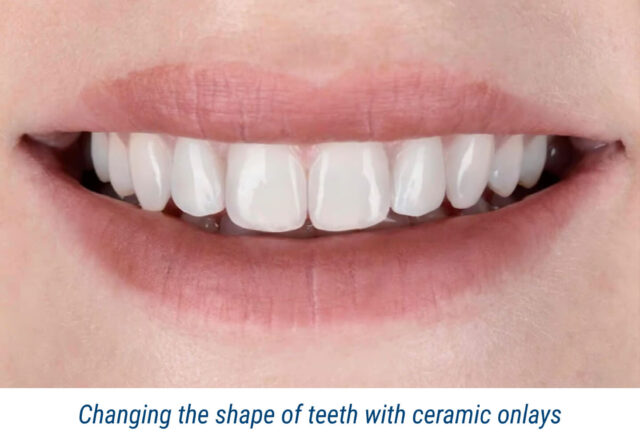
Veneers are the ideal solution for those who dream of a perfect smile but are not ready to have their teeth exposed to severe medical procedures. Ceramic onlays correct imperfections, harmonise the face and make a person feel attractive.
Indications for veneers:
- stains, darkening of enamel (when whitening is ineffective);
- anomalies in the shape or size of teeth;
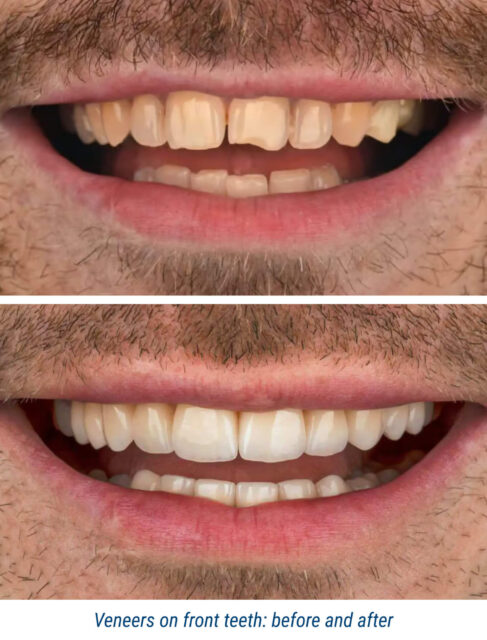
- cracks, chips of hard tissues;
- diastemas, tremas (large interdental spaces);
- minor axial rotation
Microprosthetics helps to solve these problems, provided there is no counter indication.
Veneers are not placed in the following cases:
- Serious occlusal disorders. It is necessary to undergo orthodontic treatment first.
- Increased erosion of enamel. The onlay is not attached to the dentin. If there is a loss of hard tissue volume, the veneer will not hold firmly.
- Excessive strain on the jaws. If a person grinds their teeth at night (bruxism), is used to biting their nails, opening bottles with their teeth, the veneer will not last long.
Tooth decay and gum disease are relative counterindications. Before getting micro-prosthetics, the patient must undergo treatment.
What are veneers, and how do they work?
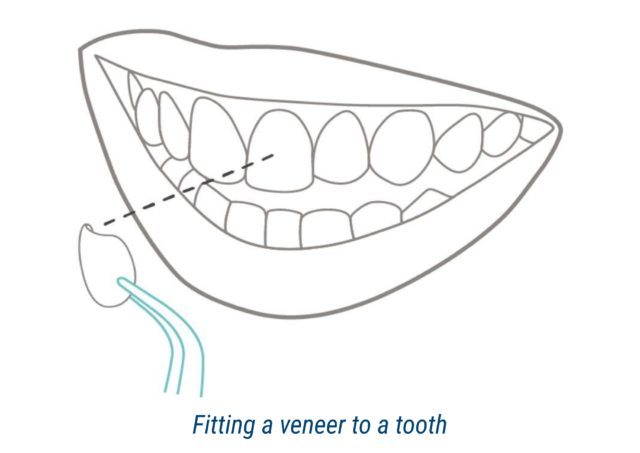
They are ceramic plates shaped like petals. The onlays are placed on the front teeth’ outer side and incisal edge.
The restoration requires some preparation. To prevent the veneers from protruding forward, the teeth are lightly ground. Since the veneers are thin, removing 0.5-0.6 mm of enamel is usually sufficient. After the teeth have been treated, impressions or scans of the teeth are taken.
While the veneers are being made in the dental laboratory, the patient wears temporary crowns. After one or two weeks, the permanent restorations are tried on, adjusted and fixed.
Advantages of veneers
- Minor tooth curvature can be corrected without orthodontic treatment.
- Unlike orthodontic treatment, the restoration requires only a few visits to the doctor.
- The placement of veneers is painless and without noticeable discomfort.
- The onlays reliably protect the front surface of the teeth from external influences.
- With the correct shade, veneers look as natural as real teeth.
Improved appearance
The main cosmetic imperfections that veneers can successfully cope with:
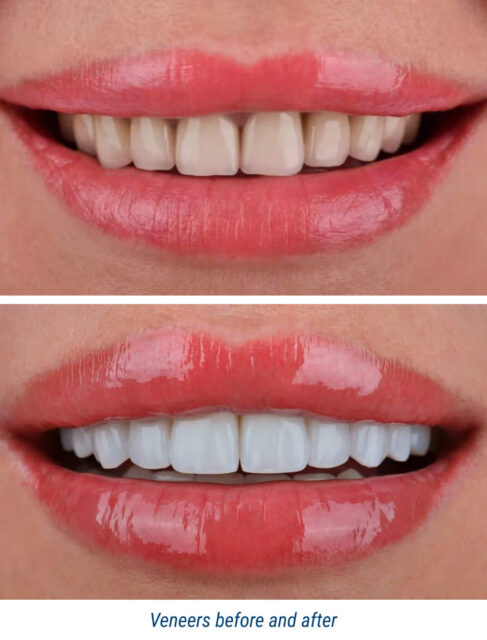
- Tooth discolouration
These are most often defects that cannot be corrected with whitening or fillings. Enamel may have uneven colouring, multiple stains, and erosions, which spoil the smile. Installing veneers is the only option to solve the aesthetic problem without radical intervention.
- Abnormalities in the size and shape of teeth
Some people have abnormalities such as microdentistry (disproportionately small teeth), crown abnormalities (screwdriver-shaped, barrel-shaped, half-moon notches or jagged edges). In these cases, veneers can not only eliminate the cosmetic defect, but also improve diction.
- Diastemas and tremas
Gaps between teeth are caused by an abnormality of the frenulum of the upper lip, partial adentia, or because the jaw is too broad. A large gap between the central incisors is called a diastema, and a trema between the other teeth. If the bite is normal and there are no problems with the mandibular joint, orthodontic treatment is unnecessary. To hide the gaps, it is sufficient to place veneers.
Durability and resistance
Veneers are resistant to the effects of food pigments. Their colour does not change when drinking black tea, coffee, red wine, or brightly coloured fruits and vegetables.
How long the restoration will last depends on following the doctor’s recommendations and caring for your teeth. Quality ceramic veneers can be worn for 10-15 years with care.
Are veneers bad for teeth?
Some patients have doubts about the safety of veneers for teeth. All types of veneers are made using biocompatible materials that do not provoke allergic reactions or cause rejection.
Enamel preparation: possible implications
Preparation is an essential step in the placement of onlays. It is necessary for:
- forming the veneer bed;
- improving the bond between the tooth and the onlay;
- correct the shape of the tooth before the veneer is placed;
- remove damaged enamel to prevent decay under the restoration.
Once the veneers have been ground, the teeth cannot be returned to their previous state – an irreversible process.
The procedure is carried out without negative consequences if the dentist does everything correctly. To minimise the risks, contact an experienced dentist, discuss the nuances of the procedure with your dentist, including the amount of clipping and expected consequences, and follow oral hygiene recommendations to prevent tooth decay.
Increased tooth sensitivity
Hyperaesthesia after veneer bonding is considered a normal reaction because, during the procedure, the dentist pulls back the gum margin and performs several manipulations. Usually, painful sensations from thermal stimuli disappear on their own after a few days. To reduce discomfort, it is recommended to use special pastes against tooth sensitivity and not consume very cold and hot food and drinks.
If the pain from irritants continues to bother you or appears long after the veneers have been installed, you should consult your doctor. The dentist will determine the cause of tooth soreness under the onlays and correct the restoration or treatment.
Disadvantages of veneers
- Limited lifespan. Products made of quality dental ceramics can be worn for decades, but you should be prepared to replace them after a certain period of time.
- Risk of unexpected results. Many patients want to become the owners of a snow-white smile and require radical brightening of the front teeth. Such onlays will look beautiful, but the smile will be unnatural.
- Mismatch in the size and shape of the teeth. When inlays are too large, it affects not only the aesthetics. Due to the violation of anatomical proportions, the load when chewing food will be distributed unevenly, the temporomandibular joint will suffer, there will be hypertonus of facial muscles.
- Gingival recession. This is possible in the case of large veneer thickness, when the voluminous edges of overlays cause excessive pressure on the periodontium; due to chronic traumatisation, the gingiva shifts, exposing the necks of the teeth.
- The risk of tooth decay with inadequate hygiene. There is a perception that veneers protect teeth from decay. This is partially true. If the veneers are properly fixed, there can be no decay on the outside of the teeth. However, such a probability is not excluded if a person has poor hygiene around the veneer.
- Ineffectiveness in case of severe curvature of teeth. Overlays can not replace the bracket system. They do not correct bite pathologies and cannot turn or move the tooth. If ceramics are installed without prior orthodontic treatment, they will quickly fall off due to overloading.
- Short-term deterioration of diction. Speech problems are most often experienced by patients whose teeth have enlarged. After a period of adaptation, diction is restored.
- Impossibility of repair. If a fragment of the veneer has broken off, the veneer will have to be replaced with a new one.
How to properly care for veneers?
Some people believe that teeth with ceramic veneers do not require special care — this is a misconception.
Indeed, deposits accumulate less on the smooth surface of the veneer than on natural enamel, but plaque is still present. In addition, the plate covers only half of the crown, so regular hygiene is necessary to prolong the veneer’s life and maintain the teeth’ health.
Do your routine in the morning and evening. Make circular movements with your brush, avoiding pressure on the veneers. Use floss daily for interdental spaces, using a paste with minimal abrasive content. A mouthwash will help freshen your breath and clean the oral cavity.
If possible, it is worth using an irrigator. With a pressurised water jet, this device removes twice as much plaque as a toothbrush. If there are no contraindications, an irrigator can be used every day.
In addition to home cleaning, professional hygiene is necessary: visiting the dentist every six months is recommended.
With all the advantages of ceramics, it is pretty fragile, so you must handle veneers carefully.
Take care of the onlays from shocks. Always use mouthguards during training if you are involved in extreme sports or martial arts.
Do not expose veneers to sudden temperature changes (this happens when drinking hot and cold drinks or food at the same time). Avoid mechanical damage—do not open bottles and cans with your teeth, and do not chew nutshells and candy.
If you treat veneers with care, you will enjoy a beautiful smile for many years.



 Out team
 Reviews
 Blog
Blog News
News Price list
 Partners
 FAQ
FAQ Vacancies
 Dental Consultation
 Tooth Decay Treatment
 Root canal treatment (endodontics)
 Orthodontics
 Dental implantation
 Dental prosthetics
 Professional oral hygiene
 Tooth Filling
 Periodontal disease treatment
 Teeth restoration
 Teeth extraction
 Surgical dentistry
 Sedation dentistry (sleep dentistry)