


 (115)
(115)


In many cases, restoring a tooth significantly destroyed by decay or trauma is possible without extracting it. Modern dentistry uses various techniques to preserve the remaining tissue and restore the smile’s beauty. Aesthetic restoration of front teeth, premolars, and molars is often carried out using fibreglass posts. This is a reliable, durable, and functional way to recreate the tooth’s anatomical shape.
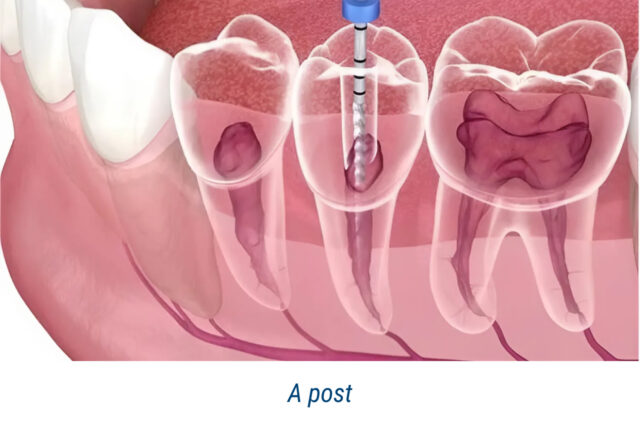
What is a fibreglass post?
A fibreglass post is a small-diameter rod inserted into the root canal to strengthen the tooth’s walls. It replaces the lost tissue and serves as a basis for restoration with composite material or an artificial crown. The rod’s physical and chemical properties are similar to those of the tooth tissue, and when adequately placed, it forms a strong monolithic structure.
Features of design and materials
The post consists of glass fibres arranged horizontally along the central axis. They are intertwined and held together by a matrix, which is crucial for the product’s durability. In terms of shape, the design comes in 3 types:
- cylindrical – rods with the same diameter along the entire length, which have high strength but are less convenient to place;
- conical – products with one pointed end, which follow the shape of the root canal and are easy to place;
- cylindrical-conical posts, which are suitable for aesthetic restorations with moderate destruction of the dental crown.

How is glass fibre used in dentistry?
Since the 1990s, glass fibre has been a popular material for dental restorations. It is obtained from silica sand, soda, and other components. At high temperatures (up to +1400°C), the mixture melts and forms liquid glass, which forms thin filaments. The fibres are then woven together to create a strong material.
In dentistry, the highest-purity glass fibres are used. The mixture contains approximately 75 per cent glass filaments and a 25 per cent bonding matrix, although this ratio may vary depending on the manufacturer and manufacturing technology.
When is a fibreglass post necessary?
Strengthening the dental canal with a post is recommended when the crown part is more than 50% destroyed, and the tooth roots remain intact. This treatment method saves the remains of the natural tooth, avoiding the placement of dental implants, bridges, or other types of prostheses.
Indications for use
Fibreglass posts are used in the following situations:
- when a significant part of the dental crown has been destroyed as a result of caries, pulpitis, or trauma;
- to form a tooth stump and prepare for artificial crowns;
- to create a solid base before tooth restoration with composite materials;
- if the patient is allergic to metals.
An essential prerequisite for restoration with posts is the good condition of the tooth roots. Fibreglass posts are used if the root canal walls are of standard thickness and there are no cysts, granulomas or active inflammatory processes in the periodontium.
Problems that the technology solves
Fibreglass products significantly improve the quality and longevity of dental restorations. Fibreglass posts made of a strong, translucent and hypoallergenic material solve several problems at once:
- high-quality aesthetic restoration of teeth in the smile area;
- durable and long-lasting restoration in the chewing section of the dentition;
- reliable fixation of an artificial crown with a minimal amount of native dental tissue;
- complete restoration of decayed teeth in just 1-2 visits to the dentist;
- restoration of teeth at an affordable price.
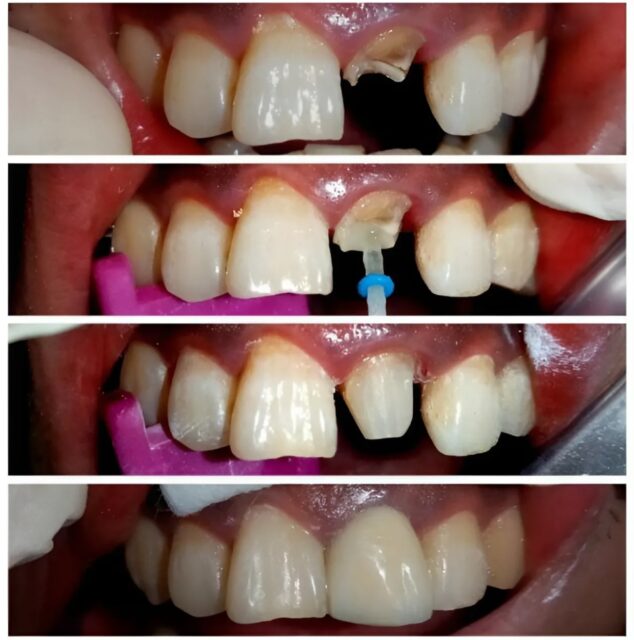
Stages of restoration of an anterior tooth with a fibreglass post
Advantages of fibreglass posts
- High aesthetics. The translucent material of the post does not show through the dental crown and does not give it a greyish shade, unlike metal products. Fibreglass is the optimal choice if the patient requires restoration of the anterior teeth.
- Biological compatibility. Fibreglass restorations do not cause rejection or allergic reactions, are not oxidised, are not subject to corrosion and do not destroy the tooth tissue.
- Stress resistance. Regarding strength and elasticity, the posts correspond to natural dentine, so they evenly distribute the load during chewing.
- Monolithic. Fibreglass structures are firmly fixed to the walls of the root canal and form one whole with it. They do not cause fractures of the tooth root due to mechanical overload, as it sometimes happens after the installation of metal rods.
- Versatility. Dental posts made of glass fibre can be placed in any part of the upper and lower jaw, regardless of the number of roots in the tooth to be restored.
How is a fibreglass post placed?
A comprehensive oral diagnosis is carried out before restoring a tooth with post in dentistry. The patient will need a consultation with the doctor, a visual examination of the dentition, and a targeted or panoramic X-ray. A CT scan may be performed to clarify the configuration of the root system and the condition of the affected tooth. Based on the examination results, the dentist draws up a restoration plan and selects the type and size of the post.
Preparation of the dental canal
In the first stage, a cavity is formed to insert the post into the tooth’s root. For this purpose, the dentist performs several manipulations:
- prepares the dental crown and opens the root canals;
- removes the nerve or filling material from the root canal cavity;
- expands the canals with special endodontic instruments;
- disinfects the tooth root with alcohol-containing antiseptics;
- treats the root canal walls with adhesive materials to improve adhesion to the composite.
The process of insertion and restoration
Light-curing restorative materials are used to place the post in the tooth. A dentist applies a thin composite layer to a fibreglass post, places it in the canal and turns on a polymerisation lamp to harden the filling. In this way, the post is firmly fixed in the tooth’s root system, and its outer part protrudes above the gum and serves as a stump for the restoration.
The final stage of treatment is inserting an artificial crown or restoration of the tooth with photopolymer materials.
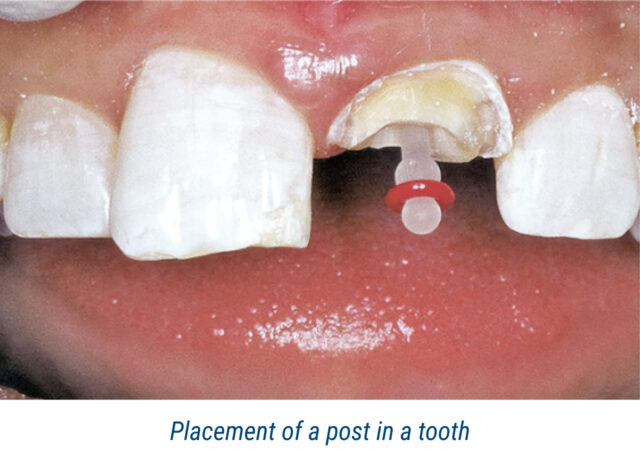
Placement of a post in a tooth is not painful, as the procedure is performed under local anaesthesia. However, in the first 2-3 days after the doctor’s visit, the restoration area may experience slight soreness and increased sensitivity. This short-term natural reaction to dental manipulation does not require additional treatment.
Care of a tooth with a post in place
A post’s warranty period is up to 10 years, but such structures last even longer in practice. The service life depends on the restoration quality and the correct home care for the teeth after.
Dentist’s advice
After inserting a fibreglass post into the tooth canal, doctors recommend following these rules:
- use low-abrasive toothpaste;
- use floss and irrigator to remove food debris from hard-to-reach areas;
- purchase an electric toothbrush for better cleaning of the surface of the teeth;
- avoid eating too hard foods;
- limit the amount of colourful foods (red wine, fruit juices, coffee, and tea) and rinse your mouth with water immediately after eating them;
- stop smoking;
- do not open plastic packaging or bottles with your teeth.
If the patient has bruxism (teeth grinding), this can lead to rapid wear of the restoration and damage to the roots of the fibreglass post. In this situation, special protective mouth guards are recommended, made in the laboratory using custom impressions of the dentition.
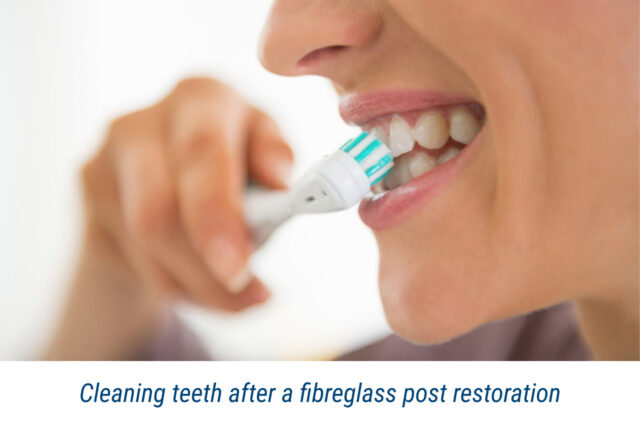
How can I extend the life of my restoration?
To prolong the life of a fibreglass restoration, it is essential to:
- follow all of your doctor’s advice regarding home oral care;
- visit your dentist every 6 months for a routine check-up and professional oral hygiene;
- treat diseases of adjacent teeth promptly;
- if pain occurs in the restored tooth, contact the dentist immediately.
The key factors for a fibreglass post’s long service life are the correct restoration method and compliance with the protocol for product placement. You should turn to experienced dentists who work with certified materials and use expert-grade equipment to get a good result. The KES Clinic successfully performs various dental restorations, including complex and non-standard clinical cases.




 Out team
 Reviews
 Blog
Blog News
News Price list
 Partners
 FAQ
FAQ Vacancies
 Dental Consultation
 Tooth Decay Treatment
 Root canal treatment (endodontics)
 Orthodontics
 Dental implantation
 Dental prosthetics
 Professional oral hygiene
 Tooth Filling
 Periodontal disease treatment
 Teeth restoration
 Teeth extraction
 Surgical dentistry
 Sedation dentistry (sleep dentistry)