


Ceramic restorations in A2 color are the ideal solution for natural restoration of the own teeth
- The patient contacted us to restore the anatomy of his damaged teeth using ceramic veneers and crowns.
- It was very important for the Patient that the new ceramic restorations didn’t differ in color fromnatural teeth.
- There was also a request to create the most natural, beautiful shape.
- The patient had multiple chipped teeth as a result of restoration with photopolymer restorations.
- Ceramic veneers and crowns were made in the frontal area of both jaws whereas the premolars and molars were covered with zirconium crowns.
- The result exceeded all the patient’s expectations.
- The final result of our work.
- The final result of our work.
- The final result of our work.
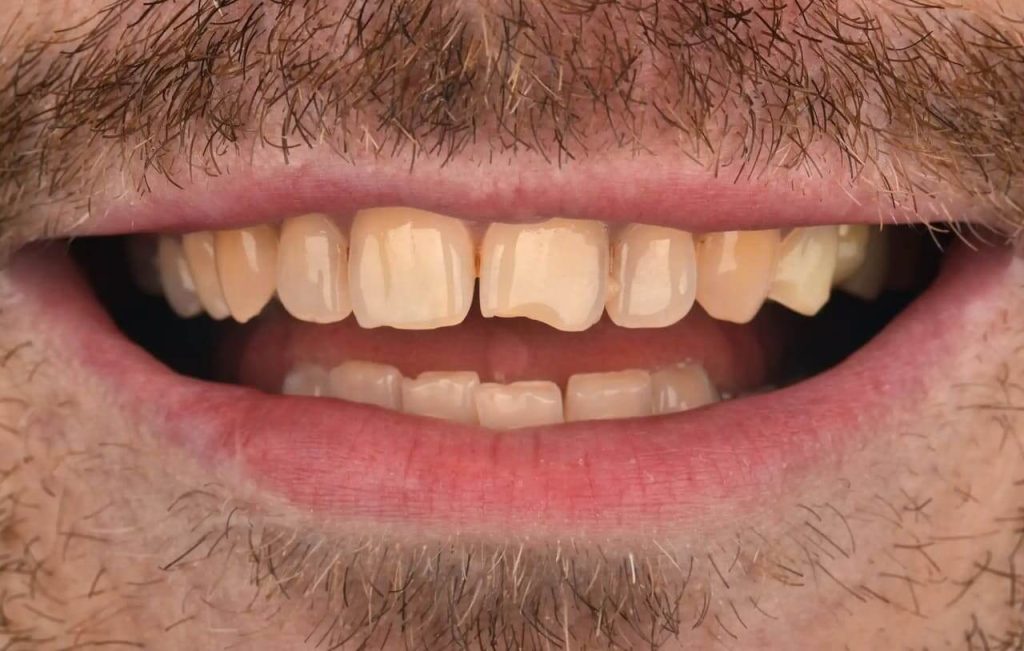
Initial situation and patient request
The patient came to the “KES Clinic of Aesthetic Dentistry” with a request to restore the anatomy of his damaged teeth with the most natural shape and color possible — without the effect of a “blindingly white” smile. Previously performed photopolymer restorations had led to multiple chips, so a durable solution with predictable aesthetics was needed. Ceramic veneers/crowns were chosen for the front teeth, and zirconium crowns for the chewing teeth; the key requirement was a color close to that of natural teeth.
Why shade A2?
Shade A2 refers to natural “unbleached” tones, it is slightly darker than A1 and provides a harmonious color characteristic of healthy enamel in adults. This choice helps to integrate new restorations into the smile without visual contrast with adjacent teeth and without a feeling of “over-whitening.” For patients who value naturalness, A2 is one of the most versatile and popular options.
Diagnosis and treatment plan
- Goal: restore shape, protect chewing teeth from further chipping, and ensure uniform color.
- Solution: ceramic veneers and crowns in the frontal area; premolars and molars – zirconium dioxide crowns for increased strength and stable shade.
- Color strategy: selection of ceramic for A2-colored ceramic restorations, taking into account the individual transparency of the enamel and transitions in the cervical/incisal areas so that the new crowns do not differ from natural teeth.
How the protocol usually works
- Smile and shade planning: photo tests/temporary crowns help to refine the shape and ensure that A2 harmonizes with natural teeth.
- Preparation and temporary structures: protect tooth tissue and allow the patient to evaluate the shape of the future permanent crowns.
- Ceramic fabrication and fixation: adhesive fixation, contact checking, and occlusion balancing for durability.
Materials and aesthetics
Ceramics provide stable shine, depth, and microtexture of the surface, thanks to which light is scattered as on natural enamel. In A2-colored ceramic restorations, it is important to balance transparency and opacity: the front teeth require naturalness and “depth,” while the chewing teeth require rigidity and wear resistance (which is why zirconium dioxide was chosen for the premolars/molars).
The result
A uniform color tone was achieved without any “steps” between the crowns/veneers and the patient’s own teeth; the shape became more symmetrical, without feeling artificial. The patient noted that the result exceeded expectations: the smile looks “natural,” and the restorations are invisible in everyday life and in photos.
Care and prognosis
Regular hygiene (soft-bristled toothbrush, gentle toothpaste, irrigator/floss).
Professional cleaning every 6 months; contact control during active loads.
Individual night guard – as indicated (for bruxism).
Avoid opening packages with your teeth and eating hard snacks.
Answers to frequently asked questions
How does A2 differ from A1 and B1? A2 is slightly darker than A1 and looks “calmer,” closer to natural enamel in adults; B1 is from a neighboring range with a different shade and is often perceived as lighter. If you are not planning to whiten your teeth, A2 helps maintain a natural balance of shades.
Is A2 suitable for everyone? Most often, yes, especially if the adjacent teeth are not whitened. For young patients with light teeth, A1 may be a better choice; for warm-toned teeth, A2 looks the most natural.
Will the restorations be noticeable? With the correct selection of ceramic transparency, A2 crowns/veneers “dissolve” into the smile and do not stand out against the background of the patient’s teeth. In our clinical case, this is exactly how color matching was achieved.
Make an appointment for a consultation at KES
Would you like to discuss A2-colored ceramic restorations for your clinical situation?
Call us at +38 0 (68) 230-83-88 or +38 0 (50) 230-83-80.
We will select the shade and material so that your smile looks natural and lasts a long time.

 Out team
 Reviews
 Blog
Blog News
News Price list
 Partners
 FAQ
FAQ Vacancies
 Dental Consultation
 Tooth Decay Treatment
 Root canal treatment (endodontics)
 Orthodontics
 Dental implantation
 Dental prosthetics
 Professional oral hygiene
 Tooth Filling
 Periodontal disease treatment
 Teeth restoration
 Teeth extraction
 Surgical dentistry
 Sedation dentistry (sleep dentistry)